Wednesday, 29 February 2012

Anatomy chart !


Monday, 27 February 2012

Hypertrophy


HST: The Complete Hypertrophy-Specific Training Guide

Hypertrophy-Specific Training™ arose out of the research looking at both the stimuli and mechanisms for muscle cell hypertrophy. Hypertrophy-Specific Training (HST) is based on physiological principles of hypertrophy first discovered in the laboratory.
These principles were then organized into a “method” of mechanically loading the muscle to induce hypertrophy. Of course, translating these principles into applicable methods (sets & reps & schedules) brings in some possibility of error. As the science continues to explore the exact mechanisms of muscle hypertrophy, this error will be whittled away.

The Beginning Of HST

I didn’t start out knowing how muscles grew. After all, it is a process that cannot be observed with the naked eye. In the beginning I simply did what others were doing. Then, I began reading muscle magazines and buying books. Still, I wasn’t able to achieve the level of muscularity I saw so prominently displayed in the magazines. For about 10 years I trained with all the popular training styles. I made decent progress in the beginning but as time went by, I seldom saw changes in the mirror, at least not any I could get anyone else to notice. But I continued to pursue the art.

It was a “fantastic voyage” compared to the European inspired global view of training. At the microscopic level scientists were talking about things like “myogenic stem cells”, “growth-factors”, “mechanical loading”, “synergistic ablation”, “smeared Z-lines”, “MAPk/ERK” and many other things hidden to the naked eye. All of these things were left out of the equation of traditional training routines.

HST Principles 


1) Mechanical Load

Mechanical Load is necessary to induce muscle hypertrophy. This mechanism involves but isn’t limited to, MAPk/ERK, satellite cells, growth factors, calcium, and number of other fairly understood factors. It is incorrect to say “we don’t know how muscle grows in response to training”. The whole point of the HST book is not to discuss HST, but to present the body of research explaining how hypertrophy occurs. Then HST becomes a relatively obvious conclusion if your goal is hypertrophy.

2) Acute vs. Chronic Stimuli

In order for the loading to result in significant hypertrophy, the stimulus must be applied with sufficient frequency to create a new “environment”, as opposed to seemingly random and acute assaults on the mechanical integrity of the tissue. The downside of taking a week of rest every time you load a muscle is that many of the acute responses to training like increased protein synthesis, prostaglandins, IGF-1 levels, and mRNA levels all return to normal in about 36 hours. So, you spend 2 days growing and half a week in a semi-anticatabolic state returning to normal (some people call this recovery), when research shows us that recovery can take place unabated even if a the muscle is loaded again in 48 hours. So true anabolism from loading only lasts 2 days at best once the load is removed.

3) Progressive Load
Over time, the tissue adapts and becomes resistant to the damaging effects of mechanical load. This adaptation (resistance to the stimulus) can happen in as little as 48 hours (Repeated Bout Effect or Rapid Training Effect). As this happens, hypertrophy will stop, though neural and metabolic adaptations can and may continue. As opposed to hypertrophy, the foundation for the development of strength is neuromuscular in nature. Increases in strength from resistance exercise have been attributed to several neural adaptations including altered recruitment patterns, rate coding, motor unit synchronization, reflex potentiation, prime mover antagonist activity, and prime mover agonist activity. So, aside from incremental changes in the number of contractile filaments (hypertrophy), voluntary force production (i.e. strength) is largely a matter of “activating” motor units.

4) Strategic Deconditioning

At this point, it is necessary to either increase the load (Progressive load), or decrease the degree of conditioning to the load (Strategic Deconditioning). The muscle is sensitive not only to the absolute load, but also to the change in load (up or down). Therefore, you can get a hypertrophic effect from increasing the load from a previous load, even if the absolute load is not maximum, assuming conditioning (resistance to exercise induced micro-damage) is not to extensive. There is a limit to the number of increments you can add to increase the load. You simply reach your maximum voluntary strength eventually.

Utilizing lactic acid as a stimulus for tendon repair & health

Now HST incorporates a few other things such as higher reps (for lactic acid) to prepare the muscles and tendons for future heavy loads. This serves as “regular maintenance”. Without it, you increase your risk of chronic injuries and pain. The metabolically-taxing reps enhance healing of strained tendons.

Compound Exercises

HST also suggests using compound exercises to maximize the effects of loading on as much muscle as possible per exercise.

Progressively Adjusting reps to accommodate Progressive Load

HST suggests that you use 2 week blocks for each rep range. Why? It has nothing to do with adaptation. It is simply a way to accommodate the ever increasing load. Of course, you could adjust your reps every week (e.g. 15,12,10,8,5,etc), but this is more complicated and people might not understand. Often times, in order to communicate an idea you must simplify things, even at the expense of perfection. If people can’t understand it, they won’t do it. What good would that do or anybody?
Then, over time, people figure out for themselves the other possibilities that exist within the principles of hypertrophy.

Low volume per exercise (average volume per week)

HST suggests that you limit the number of sets per exercise per workout to 1 or 2. This is based on “some” evidence that sets beyond the first “effective” set do little more than burn calories. There is nothing wrong with burning calories, but when you get to be my age you just don’t have the exercise tolerance that you once did. Using hormone replacement (HRT) therapy would of course, increase the number of sets you could do without undue stress.
Some may question the validity of HST not utilizing more than 1 or 2 sets per exercise. The number of sets is set low to accommodate the frequency necessary to create an effective and consistent environment to stimulate hypertrophy. Over the course of a week, the volume isn’t that different from standard splits (e.g. chest should tri, back bi, legs). (see table below)

Comparing The Volume Of HST To Traditional Routines

Instead of doing 6 sets on bench in one workout, those sets are spread over the course of a week (2 on Mon, 2 on Wed, 2 on Fri). Either way the muscle sees 6 sets each week, however, with HST the distribution of the loading sessions creates a consistent environment conducive to hypertrophy.
When you do all six sets at once, you put unnecessary drain on the central nervous system (CNS) and invite centralized overtraining symptoms and burnout.

Multiple Consecutive Eccentric Workouts

HST utilizes, when practical, eccentric workouts for 2 consecutive weeks. This suggestion is only for exercises that can be performed in eccentric fashion without risk of injury. Eccentric sets are performed with weight that exceeds their 5 rep max. This is done to extend the progression in load, began at the beginning of the HST cycle, for an additional 2 weeks. The fear of over training is no greater during these two weeks than previous weeks if volume is controlled for. Recent research has demonstrated this. (1,2,3,4,5,6,7,8,9,10,11,12,13,14,15,16,17, to name a few) Clearly, the effects of eccentric muscle actions on muscle tissue are one of the most well researched subjects in exercise physiology.
As the research continues to explore the facets of load induced muscle hypertrophy, HST will apply the new knowledge and become even more effective. For today, HST represents the state of the art and science of hypertrophy.
I have now used these principles myself, and have used them successfully to train competitive bodybuilders for some time. It is not “specifically” designed for competitive track athletes, Powerlifters or Olympic lifters, although I have had many athletes from different sports apply HST to their off-season training with ground breaking results. It is designed according to research looking specifically at muscle hypertrophy, not muscle performance.
This subject deserves a lot more attention than I am able to give it here. I will cover the topic more thoroughly in the future, including the references that first shed light on the principles that gave rise to HST. In the meantime, if you want to grow as fast as possible, you must apply currently know hypertrophy-specific training principles.

Sample HST Workout


Tuesday, 14 February 2012

Cardio!


What is cardio training?

Cardio training is exercise with the purpose of developing cardiovascular or aerobic fitness. Cardiovascular fitness is a good measure of the heart’s ability to pump oxygen-rich blood to the muscles.
Cardio training generally involves exercising at a constant moderate level of intensity, for a specified duration, during which the cardiovascular system is allowed to replenish oxygen to working muscles. Typical activities include walking, jogging, cycling, swimming, jump rope, stair climbing, and rowing.

Why is cardio training so important?

Cardio training plays a vital role in human health and performance. With regular cardio training, one can expect numerous metabolic changes.
cardio dose response 227x300 All About CardioThese include:
  • Increased cardiac output
  • Increased oxygen uptake
  • Increased blood flow to active muscles
  • Decreased sub-maximal respiratory rate
  • Increased blood volume
  • Improved thermoregulation
  • Increased mitochondrial size and density
  • Increased oxidative enzyme concentrations
  • Increased capillarization in muscle bed
  • Lower rate of all-cause mortality
  • Lower rate of cardiovascular disease
  • Lower incidence of type 2 diabetes
  • Lower rate of total body fat
  • Lower rate of colon cancer
  • Lower rate of breast cancer
  • Lower rate of osteoporosis
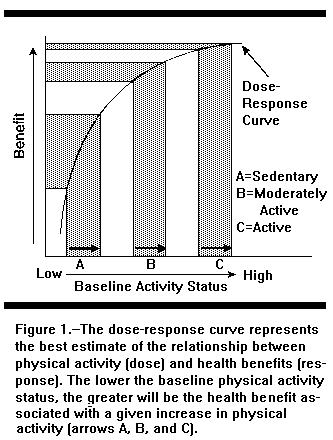
Introducing just a small amount of regular cardio training can greatly improve health (see chart above right: health benefit increases as baseline activity status increases).

What you should know

Just as with strength training, cardio training requires proper progression, variation, specificity, and overload if beneficial adaptations are to occur.
When looking at how to design an effective cardio training program, consider the following variables:
  1. Mode
  2. Frequency
  3. Duration
  4. Intensity

1. Mode

You can alter the mode of exercise to your liking and/or ability. The following activities (among others) can be used for cardio training: swimming, rope skipping, jogging, cycling, cross country skiing, stair climbing, elliptical trainer, dancing, and rowing. When choosing your activity, consider the activities you enjoy, your skill level, your joint health and the surrounding climate.

2. Frequency

Frequency is the number of cardio training sessions performed per day or per week. This will be dependent on training status and intensity. 2 to 5 sessions per week will suffice. This depends on concurrent training — in other words, what other activities and/or sports you’re doing. You can attain health benefits by expending as little as 150 calories per day via cardio training. 20 minutes of cardio training, 3 times per week can maintain cardiovascular fitness levels (assuming the intensity is appropriate).

3. Duration

Duration is the length of the cardio training session. This is directly related to the exercise intensity. Strive for 15 to 60 minutes of continuous cardio training.

4. Intensity

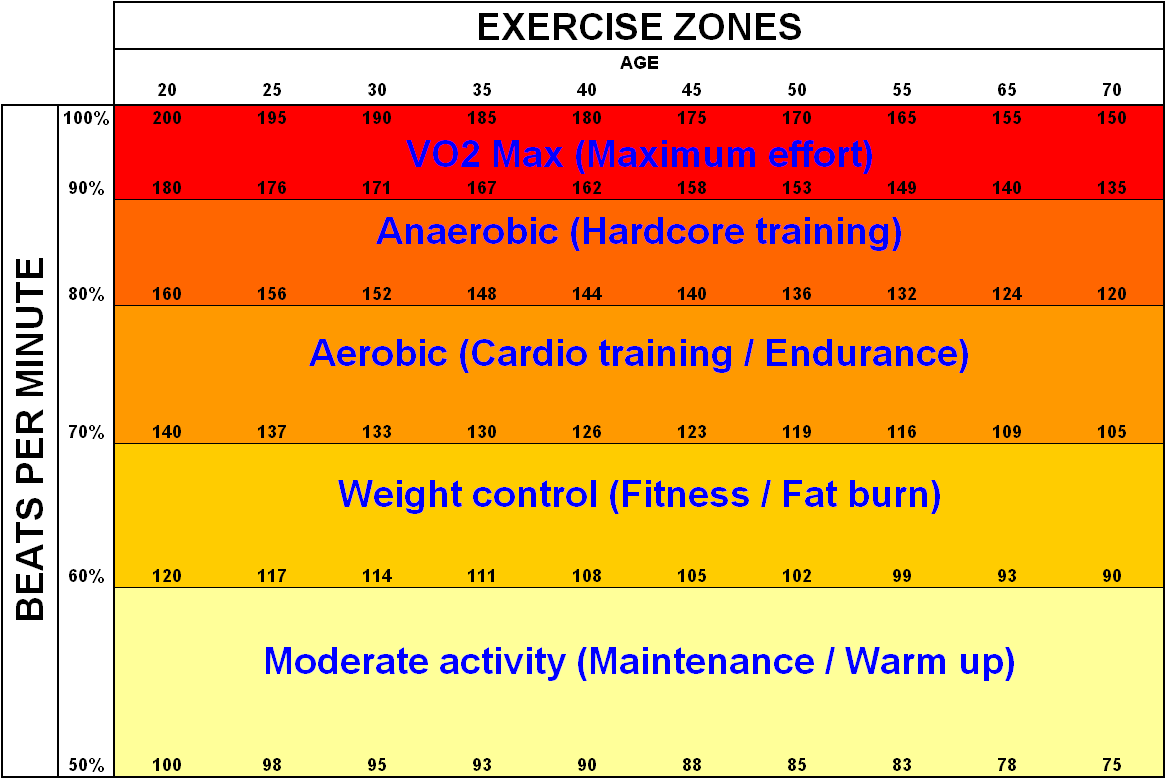
Intensity of the cardio training can be monitored via heart rate response or oxygen uptake. The most practical method is measuring heart rate using a heart rate monitor or a simple pulse count. To attain optimal cardiovascular fitness, exercise between 60-90% of maximal heart rate (50-85% of heart rate reserve).
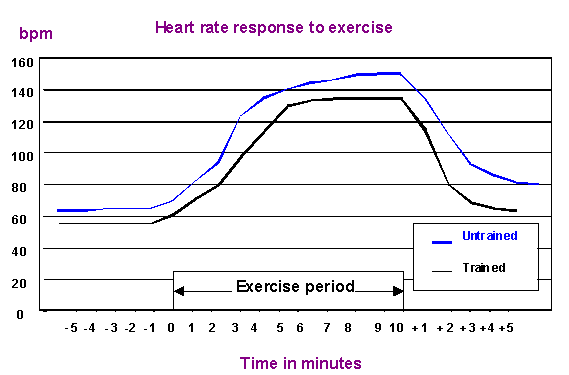
Remember that heart rate increases in a linear fashion as workload increases during cardio training. The maximal level that can be attained is dependent on fitness level, age, climate, gender, medications, etc.
Maximal heart rate can be estimated by subtracting age from 220. For example, the estimated maximal heart rate for a 37 year old would be:
220 – 37 (age in years) = 183 beats/minute
Target heart rate calculator here:
A more specific equation for determining the heart rate at which you would exercise is the Karvonen Method. This equation is as follows:
220 – age = maximum heart rate
Maximum heart rate – resting heart rate = heart rate reserve
(Heart rate reserve x training %) + resting heart rate
hr response to exercise All About Cardio
Association between heart rate and cardio training intensity
Chart that illustrates level of exercise intensity and fitness benefit:
exercise zones All About Cardio

For extra credit

Cardio training can be helpful for achieving optimal body composition because of the high caloric expenditures. It helps to lower relative percentage of body fat, but has little or no effect on muscle mass.
Cardio training tends to elicit a greater cortisol response than strength training.
High levels of cardio training are associated with protein loss from muscle, which can lead to a reduction in mass and strength. If you’re training for something that involves maximal strength and/or mass, consider keeping your cardio sessions relatively brief and less frequent.
Doing a high level of cardio training can result in a muscle fiber type shift from fast twitch to slow twitch. This would be undesirable for power athletes, sprinters, and Olympic lifters. However, this fiber type shift could be beneficial for recreational exercisers and endurance athletes.
Performing regular moderate cardio training can increase glucose and amino acid uptake in muscle and liver cells. This can be extremely beneficial for long term health. It can also greatly influence recovery from strength training.

Summary and recommendations

After you have established the total amount of time you can dedicate to exercise, set aside less than half of that time for cardio training. For example, if you are exercising 5 hours per week, then about 2.5 hours or less could be devoted toward cardio training.

When your goal is to put on muscle mass while controlling body fat

  • Perform 10 – 15 minutes of cardio training at a low to moderate intensity after strength training workouts
  • Days off from strength training should consist of recovery, high intensity interval training, dynamic flexibility/yoga, or another bout of low to moderate cardio training for 20 to 30 minutes.

When your goal is to lose body fat and maintain muscle mass

  • Perform 15 – 30 minutes of cardio training at a low to moderate intensity after strength training workouts
  • Days off from strength training could consist of recovery, high intensity interval training, dynamic flexibility/yoga, or another bout of low to moderate cardio training for 20 to 30 minutes.

Monday, 13 February 2012

Strength Training


What is strength training?

Strength training, sometimes referred to as resistance training, refers to a specialized method of conditioning that involves the progressive use of assorted resistive loads and a variety of training modalities intended to promote health, fitness, and sport specific performance.
That’s a mouthful. Let’s put it another way.
Strength training is using muscular force against resistance. Muscles adapt to any type of resistance.
The resistance can be a heavy object, one’s own body weight, elastic resistance from bands, or other types of machine resistance from pulleys or hydraulics. The heavy object could be a kettlebell, free weight, log, beer keg, rock, another person — anything that has mass.

How else can strength training be useful?

Preserves and enhances muscle mass
Strength training:
  • Preserves and enhances metabolic rate
  • Improves bone density
  • Improves glucose tolerance and insulin sensitivity
  • Lowers risk of injury
  • Improves ability to engage in daily activities
  • Improves balance
  • Improves self-esteem
  • Enhances strength and endurance
  • Enhances speed, power, and agility
  • Improves overall body composition
  • Decreases bad cholesterol levels
  • Decreases blood pressure
  • Improves aerobic capacity

Sets and reps
Generally, resistance training workouts are divided into sets of repetitions (aka reps).
Often the number of reps reflects the amount of weight used, or the technical complexity of the exercise. For example:
  • To do a set of 15 reps requires less resistance than an all-out set of 2 reps.
  • It’s easier to do a set of 15 biceps curls than a set of 15 burpees, or 15 clean and jerks.
  • If you’re looking for explosiveness, you might use lower reps. If you just want to do a moderate, controlled repetition, you can use higher reps.

Volume
Volume refers to the total amount of reps/work within a given workout or training program. For instance:
3 set of 5 reps = 15 total reps — relatively low volume
10 sets of 10 reps = 100 total reps — relatively high volume
Intensity
Intensity in this case doesn’t mean how hard you feel you’re working, but rather how heavy the weight is relative to your maximum. High intensity means you’re lifting a heavier weight; low intensity means you’re lifting a lighter weight.
For example, if you can only do an all-out rep with 100 lbs in a given exercise, that’s your 1 rep max (1RM).
  • If you use 50 lbs, that’s 50% 1RM, and low intensity
  • If you use 75 lbs, that’s 75% 1RM, and medium intensity
  • If you use 98 lbs, that’s 98% 1RM, and high intensity

Rest between sets
Generally, lifters rest between sets to allow ATP (muscle fuel) to regenerate. The rest length is also based on goals. The heavier the weight, and the more complex the lift, usually the longer the rest.
  • When training with heavy loads for strength or power, about 3 to 5 minutes of rest between sets seems to allow for greater performance in subsequent sets.
  • When the goal is improving overall body composition, the combination of moderate-intensity sets with short rest periods of 30-60 seconds might be most effective due to the metabolic cost and greater levels of growth hormone and testosterone.
  • Very short rest periods of 20-40 seconds can result in better muscular endurance.


Exercise/movement types
In most cases, complex movements that involve many moving joints are best.
  • For strength and power, focus on complex, multi-joint, “movement plane” exercises such as squats, deadlifts, pullups, rows, weighted jumps, etc. You can also use “functional” type exercises such as sandbag carries, sledgehammer swings, and tire flips.
  • For muscle mass gain, you can use strength and power-type exercises (with medium loads) as well as targeted body part isolation exercises, such as biceps curls or triceps extensions.
  • For endurance (for sport or rehab), you can use strength and power-type exercises (with lighter loads) as well as targeted body part isolation exercises.
  • Many rehab-type exercises involve building endurance in specific body parts using very small movements (such as arm raises) with very light loads.
The chart below shows approximately what types of reps, sets, and other variables might help you meet specific goals.
GoalExercise typeIntensitySet durationVolumeRep speedRest
Max strengthComplex, multi-joint, “movement plane”80-100% 1RMShort
(1-5 reps)
LowerMedium-fastLong:
3-5 min
PowerComplex, multi-joint, “movement plane”70-100% 1RMShort
(1-5 reps)
LowerFastLong:
3-6 min
Muscle mass gain
(hypertrophy)
Complex, multi-joint, “movement plane” or targeted, body part isolation60-80% 1RMMedium
(6-12 reps)
HigherMediumMedium:
30 sec to 2 min
Endurance
(for sport or rehab)
Complex, multi-joint, “movement plane” or targeted, body part isolation40-60% 1RMLonger
(12-15 reps or more)
HigherMediumShort:
20 sec to 2 min

Progression
There are many different ways to make progressions.
  • You can increase the weight lifted, the repetitions performed, or the sets completed.
  • You can also decrease the tempo of each set to allow greater time under tension. Decreasing the rest between sets doesn’t allow your body to fully recover and is metabolically taxing.
  • Even changing the biomechanics of how we do an exercise can be a method of progression (e.g., flat to incline, supinated to pronated, bent to straight, etc.).
Making it tougher
Finally, there are many ways to boost intensity with strength training. Here are some examples:
Supersets
Supersets alternate two or more exercises from set to set.
Example – 1 set of bench press; 1 set of dumbbell rows; 1 set of bench press; 1 set of dumbbell rows, etc.
Drop sets
Drop sets start with a heavier weight, then decrease the weight on subsequent sets.
Example – 10 reps with 100 pounds on squats, 8 reps with 80 pounds on squats, 6 reps with 60 pounds on squats, and so on….
Rest/pause
Rest/pause sets involve reps to fatigue, rest briefly, then do a few more reps, rest briefly, do a few more reps, and keep going until total failure.
Example – 10 reps with 100 pounds on squats, rack it, rest, 4 reps with 100 pounds, rack it, rest, 3 reps with 100 pounds
Circuits
Circuits string two or more exercises together with minimal rest in between. The lifter typically rests for a longer period after each “round”.
Example – 8 reps of pushups, 8 reps of deadlifts, 8 reps of rows, 8 reps of lunges, 30 seconds of jumping jacks, rest.
Density training
Density training involves the lifter selecting a given time limit, then trying to do as many reps as possible within that time limit.
Example – Doing pushups and pull ups for 10 – 15 minutes with minimal rest.
Negatives
Each rep has a “positive” or concentric portion (the portion where resistance is heaviest, as in the “up” part of a biceps curl), and a “negative”, or eccentric portion (the portion where one is simply resisting/controlling the resistance as it returns to the start, as in the “down” part of a biceps curl). Negative sets involve slow, controlled eccentrics, and usually an assisted concentric.
Example – Jump up to a pullup bar so your chin is above the bar; slowly lower yourself down. Here, the jump provides assistance on the “up” part.
Isometrics
Isometrics involve holding a particular static position under resistance.
Example – wall sit for 30 seconds

Planned variation
You won’t get very good results if you just wander from machine to machine, or do the same things all the time.
You also won’t get good results if you choose the wrong approach for your goals (e.g. an endurance workout if you actually want to improve your maximal strength).
Plan your workout so that:
  • you know in advance what you’re doing;
  • you’re not always doing the same exercises/sets/reps;
  • you vary the loading; and
  • you get enough rest and recovery.

Summary and recommendations

Strength training involves moving against resistance.
Anyone can strength train.
Strength train for 2 to 3.5 hours per week, distributed evenly.
Participate in a progressive warm up before strength training.
Your strength training routine should reflect your goals.
  • For strength, try more heavy sets with fewer reps.
  • For metabolic conditioning and endurance, try fewer moderate weight sets with higher reps.
  • For hypertrophy, aim for more total reps, with moderate to heavy weights.
Think about movement choice.
  • Focus on body part workouts if you are more interested in regional hypertrophy.
  • Focus on complex, “movement plane” workouts if you are more interested in function, performance and strength.
Do the most taxing exercises first in your routine.
Vary your routine. The best program, as the saying goes, is the one you’re not currently doing.
Don’t forget about progression — otherwise, you probably won’t progress.
It’s virtually impossible to excel at strength training without good nutrition habits. No matter how awesome your routine is, if your nutrition is poor then you won’t make many gains.

Sunday, 12 February 2012

Baking Soda a Pre-workout?!! YES!


“In my reading over the past year I had come across suggestions that maybe taking sodium bicarbonate or sodium citrate could help performance during racing events. I understand that increased intramuscular hydrogen ion concentration can impair performance by messing with ATP production and competing with the calcium ion binding sites messing with contractile process. I also understand from my reading that by boosting the blood buffering capacity could increase time to exhaustion during these high intensity racing sprint intervals. What do you think?”
Before I answer this question, let’s examine a few basics of human physiology and exercise performance. When you exercise by jogging, cycling, lifting weights, or playing any sport, your muscles produce waste and breakdown products. These products build up in your muscles, and one of the biggest waste products of exercise is lactic acid. Lactic acid build up in your muscles is what makes your muscles burn during sprints or when trying to complete that last repetition on the bench press. The type of exercise you perform also affects how quickly this lactic acid accumulates in your muscles. The more anaerobic the exercise, the faster the lactic acid levels climb in your muscles. A maximum effort weight training session or a 40 yard sprint workout tends to make lactic acid levels soar much faster than a slow five mile jog since the first two are much more anaerobic.
The body does have its own buffer system to prevent muscle pH from rising lactic acid and the muscle tissue becoming acidic. However, as a workout continues your body’s natural buffering system becomes unable to keep up with the acid levels. There are three main substances that buffer muscle cell tissue from rising pH levels and hydrogen ions: carnosine, phosphate, and bicarbonate. Interestingly, bicarbonate only accounts for less than ten percent of the body’s buffering potential. The body’s primary buffer in muscle tissue is carnosine with phosphate the secondary buffer.
Where sodium bicarbonate becomes more important to athletes in terms of buffering potential is in the blood. Exercise not only increases the acidity in your muscles but also acidifies your blood as well. When lactic acid levels rise in your blood, you get exercise-induced fatigue. The main buffer in the blood is sodium bicarbonate. This is how the idea came for athletes to ingest baking soda, otherwise known as sodium bicarbonate, to buffer their blood and muscles from acid. The concept was that by taking baking soda an athlete could train harder and longer because the added sodium bicarbonate would delay the rise in lactic acid levels.
The baking soda you eat or drink never makes it to your muscle tissue because it can’t make it through the muscle cell membranes, but it does make it into your blood stream. Because your body is always trying to reach a state of equilibrium, when your ingest the bicarbonate, it lowers your blood pH. This creates a gradient that brings the lactic acid out from the muscle tissue and into the blood stream, thereby lowering the pH of your muscle as well. Next, let’s examine how well this actually works on improving athletic endurance, performance, and time until exhaustion.
It has been well documented in the scientific literature that supplementing with bicarbonate does improve performance. One study gave athletes 200mg/kg bodyweight, about 18 grams for a 200 lb athlete. The athletes then performed five successive 60 second sprints on a stationary bike, with the last sprint lasting until the athlete reached exhaustion. The bicarbonate improved time until exhaustion by 42%. Another study gave athletes 300mg/kg which equals 27 grams for a 200 lb athlete. In this study college varsity track athletes ran an 800 meter sprint. The baking soda improved times by an average of 3 seconds or a distance of 19 meters. In elite runners such as these collegiate track athletes, cutting three seconds off your 800 time is a huge improvement. In rowers taking this same dose of 300mg/kg, the baking soda group rowed 50 meters further in a six-minute time trial over the placebo group. Most studies that have shown beneficial performance effects of supplementing with sodium bicarbonate have used high doses, over 200 mg/kg, and short high intensity exercise lasting less than six minutes.
What about side effects from taking baking soda before a workout? The most commonly reported side effect is intense gastrointestinal distress. Try this simple experiment in your kitchen. In a bowl add some baking soda, now pour some water or vinegar over the baking soda and watch what happens. This is what happens in your stomach, intestines, and colon. Over half of all athletes who took the baking soda developed severe diarrhea. Also, let’s not forget about the terrible taste of ingesting baking soda as well. In order to minimize the gastrointestinal side effects, athletes should divide the large dose into several smaller doses taken before a competition. One other side effect of the baking soda is the large amount of sodium that you are taking. A twenty-gram dose of baking soda contains five grams of sodium. This can cause havoc to one’s blood pressure.
In terms of the legality baking soda is not banned by the IOC, NFL, NBA, NHL, Major League Baseball, or NCAA. In summary, sodium bicarbonate is a cheap, legal supplement that has proven performance effects for short intense exercise lasting less than six minutes, but has some major problematic side effects. An athlete should not experiment with taking baking soda for the first time before a big competition or race. He or she should test how they tolerate taking baking soda in a practice. This way there are no additional surprises or games ruined by bathroom trips.


Goodluck and follow us :)


Thursday, 9 February 2012

Afterburn, do cardio !


You have heard a lot about the “Afterburner Effect” lately. What exactly is it and how do you use it? Do you have to buy anything? Of course not! Its simple and easy to activate your “fat afterburner”!
To lose fat you either have to eat less, … or …, you can increase how much your body burns! I don’t know about you but I like eating so I’d much rather increase how much my body burns! Turns out that its really quite easy to get your body to turn on its metabolic afterburners and burn more calories.
We’ve all see the activity calculators, the ones that say if you jog for 30 minutes you burn off 325 calories – these are very misleading and pessimistic. Back in 1918, Harris and Benedict discovered that doing cardio caused the body to burn up way more calories than these charts predicted. Doing cardio puts the bodies metabolism into overdrive so that it continues to burn more calories for around 24 hours after the exercise stops. Harris and Benedict came up with some formulas which predict the how much these fat afterburners will burn up.
Lets look at a great example, ME! If I did no cardio, my daily energy need would be 2600 calories. The below chart shows how much afterburner effect I get for a given daily amount of cardio:
Minutes CardioCardio BurnsAfterburner Effect BurnsTotal Cals BurnedPounds Fat Lost
none0 cals/day0 cals/day2600cals/day0.0lbs/wk
20min/day230cals/day70cals/day2800cals/day0.6lbs/wk
35min/day400cals/day360cals/day3360cals/day1.7lbs/wk
50min/day570cals/day580cals/day3750cals/day2.3lbs/wk

You will note that at 20min/day, its negligible but when you up it to 35min a day it really starts to kick in! By 50min a day, the fat afterburner is in overdrive chomping up 580cals a day while I sit and do nothing.
So what’s happening here? Its nothing complicated, mysterious, or fancy as many would have you believe. Its just that cardio raises your metabolic rate. Just as hibernation lowers metabolic rate to near zero, high activity sends the metabolic rate thru the roof. Interesting question, what qualifies as “cardio“. Definitely traditional steady state cardiovascular exercise like walking, jogging, swimming, and biking. Perhaps interval training, its unclear. The Tabata supporters would have you think that 4min of Tabata is all you need to do, personally I feel that is some very wishful thinking. At best I would say that 20 minutes of intervals is like 35min of running. One thing that IS clear, you must do the cardio every day! The afterburner effect only seems to last about 24 hours so you need to do cardio daily if you want the effect. Doing a 7 hour run on sunday burns off fewer calories than doing a 30 minute jog each day and the 7 hour run will kill you :)
Now you see why doing cardio is very important to losing fat and getting 6-pack abs. Its not so much the calories burned during the cardio that is important but the fact that the cardio puts your metabolism into overdrive to burn up fat!
People always ask if they can lose fat and get 6-pack abs without doing cardio, and the answer is – “Yes, but its really really hard”. Why struggle? Use your fat afterburners!

Tuesday, 7 February 2012

Alcohol and Bodybuilding donot mix !


If you are serious about adding muscle and getting 8-pack abs, alcohol is enemy #1. Alcohol and bodybuilding do NOT mix. There are two great reasons to avoid alcohol if you are a bodybuilder: 1) because it inhibits gaining muscle mass and 2) because it makes you fat. Having A beer or glass of wine once or twice a month is not a problem, what I am talking about is daily drinking or weekend binge drinking.
Quick quiz: Drinking one beer a day will add how much fat in one year?
a) 3 pounds of fat
b) 7 pounds of fat
c) 12 pounds of fat
d) 15 pounds of fat
Choice D. Pretty unbelievable isn’t it. Drink just one beer a day and you add 15lbs of fat in a year. Small changes in diet can have huge effect over time! So just cut out that one beer you have with dinner every night and you can lose 15lbs of fat without running a single mile!!! How easy is that?
People who like to drink cling to the report published a few years ago that drinking red wine might be good for your heart. First of all, the study suggested but not proved this correlation. Second, bodybuilders  are very health conscious and they are at very low risk of heart disease anyway. They are not overweight, get lots of cardio, eat lots of vegetables, fruits and have a lowfat diet. The lowered risk of heart disease seems to be related to the anti-oxidants found in red wine but there are many healthier, and lower calorie, ways to get antioxidants. Another sobering statistic for those clinging to the reports that “Alcohol is good for the heart” is that a 24 year old is FOUR times as likely to die from alcohol related causes than they are to die from heart problems.
Now some of you are thinking that you already have 6-pack abs and that drinking 2-3 beers every day and partying every weekend hasn’t hurt YOUR bodybuilding – WRONG! Drinking HAS hurt you dearly in your ability to add muscle. The quality of every calorie counts when you are a bodybuilder. Those 450 calories in those three beers at dinnertime have zero nutritional value. Instead you could have eaten three broiled chicken breasts and got some quality, low fat protein or with those 450 calories you could have eaten a huge pile of steamed vegetables packed with vitamins. Many people accuse me of being a Nutritional-Nazi and tell me to lighten up but nutrition is critically imporant to bodybuilding. If you have “just one beer’ with dinner and “just one donut” at breakfast and “just one double cheeseburger” at lunch and “just one peanut butter sandwich” for a snack, then suddenly your diet looks remarkably like the average person and you will be fat and weak like the average person! Many people dont believe my claim that you can gain muscle and lose fat at the same time and its usually the same people who tell me to “lighten up” about nutrition!!!
Another big problem with alcohol is that it prevents the body from being able to absorb fat soluble vitamins like A, D, K, &E. When you drink daily you are neutralizing the healthy things you have eaten which can leave you malnourished and malnourished bodybuilders cant add muscle. With 3 or more drinks your strength and endurance are lowered for up to 48hrs and you cant add muscle if you are too weak to push your maxes. Drinking so much that you get a hangover can set you back an entire weeks worth of bodybuilding progress between the wasted calories, the lack of sleep, the dehydration, vitamin mal-absorption, and the lack of motivation that follows a drinking binge.
Now lets talk about alcohol, supplements and your liver. Your liver is a big filter that gets all the toxic crap out of your blood and like any filter, it has a limited capacity. If you drink too much you can die from alcohol poisoning because your liver cant filter it out fast enough. Supplements can also be very, very hard on the liver. Liver problems due to creatine and other supplements are very common, its the supplement industries dirty little secret. If you INSIST on taking supplements (which I don’t recommend) then its a bad idea to drink any alcohol at all – not even a single drink. Leave your liver at 100% capacity to filter out the toxic crud found in supplements.